



Return of Serve for Beginners: The 3-Rule System to Get More Balls Back
Most beginners think returning serve is about swinging harder. However, the return of serve is really about timing, simplicity, and smart targets. If your opponent’s serve feels “too fast,” it usually means your preparation is late or your swing is too big.
This guide teaches how to return serve in tennis using a beginner-friendly 3-rule system. You will learn what to do on first serves, second serves, and in doubles without overthinking.
At Infinity Racquet Club in Fulshear, TX, we coach players to build a return that holds up under pressure. Once you get more returns in play, rallies start on your terms instead of theirs.
Why Returning Serve Feels Hard (And Why It Gets Easier Fast)
When you return serve, you have less time than any other shot. Therefore, small mistakes get punished quickly:
- Late split step
- Big backswing
- Trying for corners too early
- Standing in the wrong spot
The good news: you do not need a perfect return to win points. You need a reliable return that starts rallies and forces one extra ball from the server.
The USTA also emphasizes returning with higher-percentage patterns and smart targets depending on serve location. (See USTA guidance on returning first and second serves.)
Reference: USTA return strategy guidance on first/second serves.
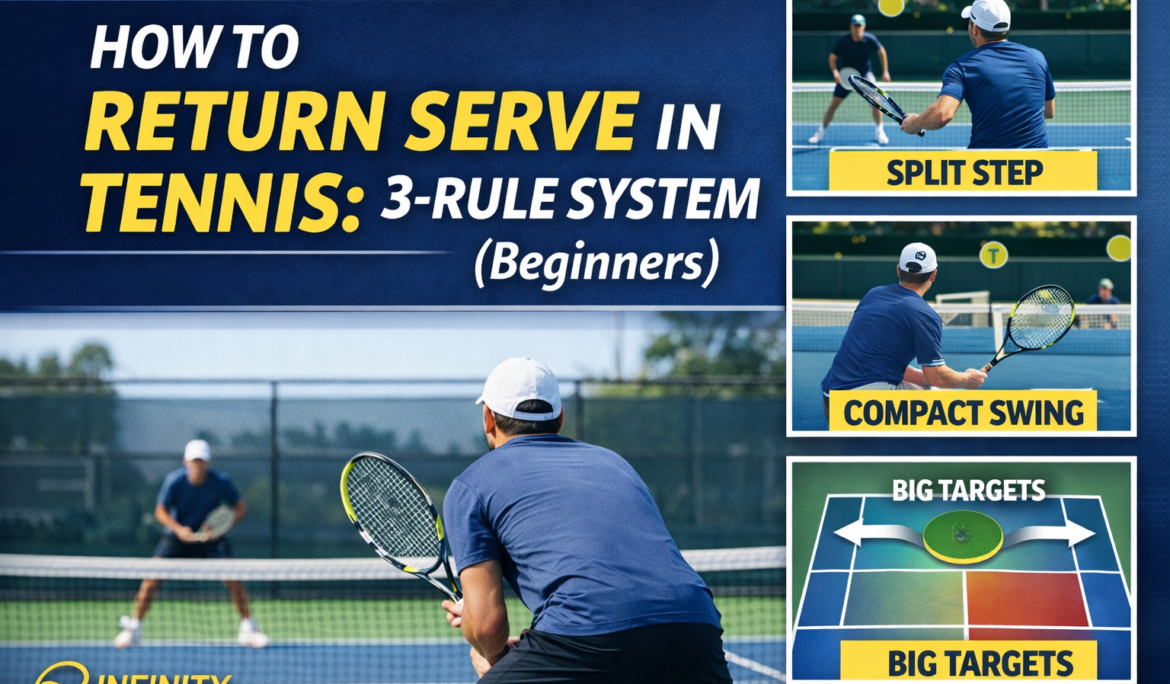
The 3-Rule System: How to Return Serve in Tennis (Beginner Version)
Use this system every time you return. It keeps you calm and consistent.
Rule 1: Split Step on Time (So You Move First, Not Panic First)
The split step is your “start button.” If you split step late, you will feel rushed. If you split step early, you will feel stuck. The goal is to land your split step as the server makes contact or just before you react to the ball.
- Stay athletic with knees soft
- Small hop, not a big jump
- Land balanced and ready to push
Research supports the split step as a key movement pattern in tennis for quick response and efficient direction change. (Split-step performance research is widely discussed in sports science.)
Reference: Split-step timing research and coaching resources.
Beginner cue
As the server starts the forward swing, your body should be getting ready to “hop and land” so you can move instantly.
Rule 2: Make Your Swing Smaller (Compact Take-Back Wins Returns)
On returns, big backswings create late contact. Therefore, your goal is to shorten the swing and let the serve’s pace help you.
- Use a compact backswing
- Turn the shoulders slightly
- Keep the racquet in front more often
- Think “block and guide” against fast serves
When the serve is fast, your return should look simpler. Many coaches describe it as a controlled block with direction rather than a full groundstroke.
Beginner cue
If you feel late, shorten the backswing by 50% immediately. You will start finding the ball more often.
Rule 3: Aim Big Targets First (Middle/Deep Beats Fancy)
Beginners miss returns because they aim too small. Instead, aim for big targets that keep the ball in play and push the server back.
- Aim crosscourt when the serve is wide
- Aim middle when the serve is body or down the T
- Prioritize depth over angles
The USTA specifically recommends higher-percentage patterns such as crosscourt returns on wide serves and middle returns on body/T serves. This is one of the easiest ways to learn how to return serve in tennis with quick improvement.
Reference: USTA return strategy: crosscourt on wide, middle on body/T.
Where to Stand: Return Position for Beginners
Return position changes everything. If you stand too close, you feel rushed. If you stand too far, you lose aggression.
Simple positioning guide
- Against fast first serves: Stand 1–2 steps behind your usual baseline position
- Against slower serves: Stand on or slightly inside the baseline
- Against kick serves: Give yourself space and aim higher over the net
Beginner cue
If you are late, move back. If you are early and comfortable, move up gradually.
How to Return First Serve vs Second Serve
This is where most beginners get confused. Use a simple rule: Survive the first serve, attack the second serve.
First Serve Return (High-Percentage Return)
- Compact swing
- Big target (middle or crosscourt)
- Deep return preferred
- Do not go for lines
Your goal is to start the rally and make the server hit another ball.
Second Serve Return (Step In and Take Time Away)
- Step in slightly
- Contact ball earlier
- Drive with controlled aggression
- Aim deep middle or to the weaker side
USTA advice also emphasizes stepping in on second serves to be more aggressive.
Singles Return Strategy (Beginner-Friendly Patterns)
In singles, your return goal is to neutralize and then take control of the rally.
Best patterns for beginners
- Wide serve: Return crosscourt (big target)
- Body serve: Return middle (remove angles)
- T serve: Return middle or crosscourt depending on comfort
If you want the serve-side strategy too, pair this guide with our related post: Where to Serve in Tennis: Simple Targets That Win Points.
Doubles Return Strategy (Even Easier Than Singles)
Doubles returns are simpler when you follow one priority: return low and through the middle to reduce the net player’s options.
Best doubles return targets
- Middle of the court (reduces angles)
- Low over the net (harder to volley)
- Deep enough to prevent an easy poach
Beginner cue
In doubles, avoid sharp angles unless you are very confident. Middle returns win more points than most players expect.
The 10-Minute Practice Plan (No Coach Needed)
Use this mini-plan at least twice per week to improve quickly.
- Split-step reps (2 minutes): Practice split step timing with a partner’s shadow swing.
- Compact swing returns (4 minutes): Partner serves at 60% pace. You return with short backswing only.
- Big target drill (4 minutes): Aim every return deep to the middle third of the court.
Track how many returns you make out of 10. Try to improve by just 1 per session. That progress compounds fast.
Common Return Mistakes Beginners Make
- Starting too low: Stay athletic but relaxed.
- Big backswing: Shorten immediately on first serves.
- Aiming for corners: Aim big first, then add precision.
- Watching the ball only: Watch the server’s toss and swing cues early.
- No recovery: After contact, recover quickly to a ready position.
Why Coaching Helps Your Return Improve Faster in Fulshear, TX
Many players search for tennis lessons near me or private tennis lessons in Fulshear TX because the return of serve feels stressful and inconsistent. With coaching, small technical changes produce fast results.
At Infinity Racquet Club:
- Coaches help fix timing, split step, and contact point
- We build simple return patterns for singles and doubles
- Players learn how to handle pace without panicking
Visit us at 6215 Teal Rd, Fulshear, TX 77441. We are open daily from 6:00 AM to 11:00 PM.
Frequently Asked Questions
How to return serve in tennis if it is too fast?
Move back 1–2 steps, shorten your backswing, and block the ball back with a big target (middle or crosscourt). Do not swing bigger to “match” speed.
What grip should beginners use on return of serve?
A neutral, ready grip that allows quick switch to forehand or backhand is best. Many beginners start close to a continental or slightly toward backhand to react faster.
Where should I aim my return as a beginner?
Aim deep to the middle third of the court first. If the serve is wide, crosscourt is typically the highest-percentage target.
Should I attack the second serve?
Yes, but with control. Step in slightly, take the ball earlier, and aim deep rather than going for corners.
Final Takeaway: The Simple Way to Get More Returns Back
If you want to learn how to return serve in tennis quickly, follow the 3-rule system:
- Split step on time
- Compact swing
- Big targets first
If you want hands-on help, book a free trial session at Infinity Racquet Club in Fulshear.
Call 346-318-3556 or visit infinitefuturetennis.com to get started.
This article was created with the assistance of AI technology.