




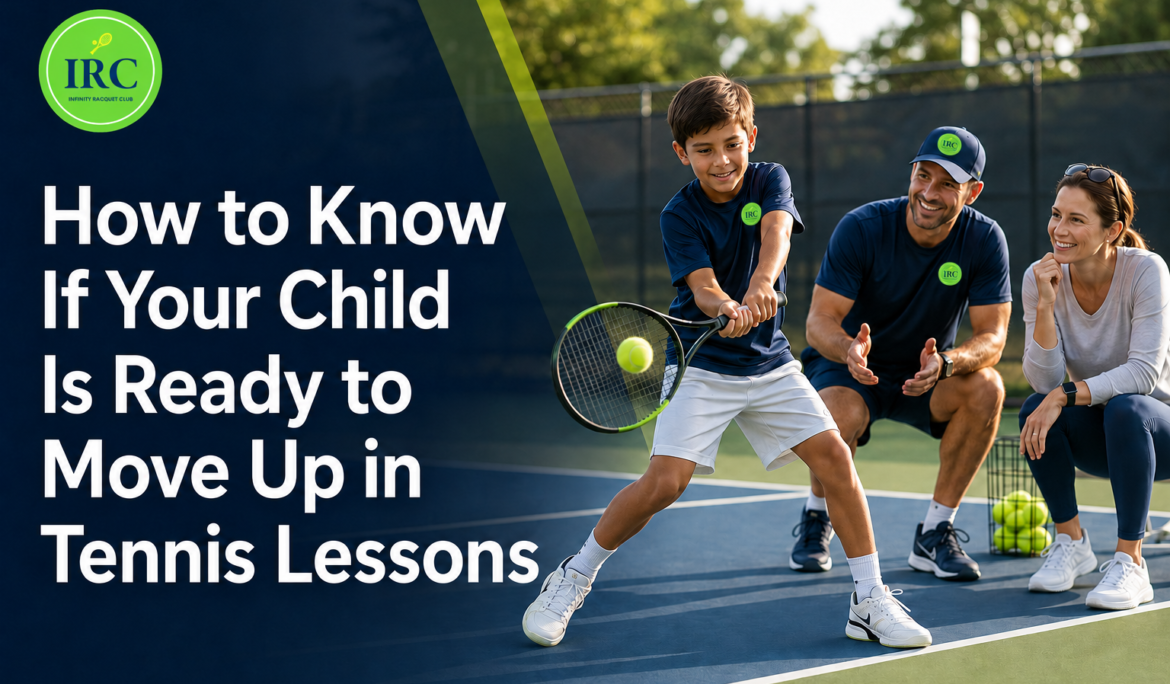
How to Know If Your Child Is Ready to Move Up in Tennis Lessons: Katy Parent Guide
Parents often wonder when their child is ready to move up in tennis lessons. Your child may be rallying better, serving with more confidence, or asking for tougher drills. However, moving up too early can create pressure. Moving up too late can cause boredom.
That is why level progression matters.
A good Tennis Lesson should challenge your child without overwhelming them. It should help them improve technique, confidence, movement, and match awareness step by step. For families in Katy & Fulshear, Infinity Racquet Club, also known as IRC, offers a structured environment where junior players can grow at the right pace.
IRC is located at 6215 Teal Rd, Fulshear, TX 77441 and serves families across Katy, Fulshear, Cinco Ranch, Cross Creek Ranch, Firethorne, and nearby communities. The club is open daily from 6:00 AM to 11:00 PM, which gives families flexible options for lessons, practice, and court time.
This Katy parent guide explains the signs your child may be ready for the next level in tennis lessons.
Why Moving Up at the Right Time Matters
Tennis development is not only about age. It is about readiness.
Some children improve quickly because they practice often. Others need more time to build control, confidence, and coordination. Therefore, parents should not compare their child too closely with other players.
The right level helps your child:
- Stay motivated
- Learn proper technique
- Build confidence
- Avoid frustration
- Enjoy healthy competition
- Develop match skills
- Improve safely
If the lesson is too easy, your child may lose interest. However, if the lesson is too difficult, your child may feel discouraged.
The goal is balance.
What “Moving Up” Means in Tennis Lessons
Moving up in tennis lessons usually means your child is ready for a more advanced group, harder drills, faster rallies, or more competitive play.
This may include:
- Moving from beginner to intermediate
- Moving from red ball to orange ball
- Moving from orange ball to green ball
- Joining a higher-level junior clinic
- Starting match-play sessions
- Adding private lessons
- Preparing for tournaments
- Training with older or stronger players
At IRC, the club promotes junior development, expert coaching, and programs for different player levels. The club also highlights certified coaches, junior-to-adult development, maintained courts, events, and a welcoming tennis community.
A move-up decision should come from progress, not pressure.
1. Your Child Can Rally Consistently
One of the clearest signs your child is ready to move up in tennis lessons is rally consistency.
A beginner may hit one or two balls in a row. A child ready for the next level can usually rally several balls with control.
This does not mean every shot is perfect. However, your child should show that they can:
- Track the ball
- Move into position
- Make clean contact
- Recover after the shot
- Keep the ball inside the court
- Adjust after mistakes
For example, if your child can rally 6 to 10 balls with a coach or similar-level player, they may be ready for more advanced drills.
Consistency shows that your child is no longer just “trying to hit.” They are learning how to play.
2. Your Child Has Better Footwork
Many parents focus only on the swing. Coaches look closely at the feet.
Footwork is one of the biggest signs of tennis readiness.
Your child may be ready to move up if they can:
- Start in a ready position
- Split step before the ball arrives
- Move sideways with balance
- Recover after hitting
- Avoid standing flat-footed
- Adjust to short and deep balls
- Stay active between shots
A child who reaches for every ball without moving may not be ready yet. However, a child who naturally moves toward the ball is showing real progress.
Better footwork means the child can handle faster drills and stronger rallies.
3. Your Child Understands Basic Technique
Before moving up, a player should understand the basic strokes.
They do not need perfect technique. However, they should know the foundation.
A child ready for the next level usually understands:
- Forehand grip and swing path
- Backhand basics
- Ready position
- Basic serve motion
- Volley position
- Follow-through
- Contact point
- Recovery position
If your child still changes grip randomly or swings without control, they may need more time at the current level.
A good coach will not rush the move. They will build the basics first.
4. Your Child Can Follow Coach Instructions
Tennis progression is not only physical. Listening skills matter too.
Higher-level lessons usually move faster. Coaches give more detailed instructions. Players must pay attention, remember drills, and make corrections during play.
Your child may be ready to move up if they can:
- Follow multi-step instructions
- Listen while other players are hitting
- Apply coach feedback
- Stay focused during drills
- Respect court rules
- Handle corrections calmly
- Ask useful questions
This is especially important in group lessons. A child who listens well will improve faster and stay safer on court.
5. Your Child Wants More Challenge
Motivation is another strong sign.
If your child says the lesson feels too easy, it may be time to speak with the coach. However, parents should look for more than one comment.
Your child may be ready if they:
- Ask to play stronger players
- Want to rally longer
- Enjoy competitive games
- Practice at home
- Watch tennis videos for learning
- Ask about tournaments
- Want to improve their serve
- Show excitement before lessons
This type of interest shows ownership.
A child who wants challenge is more likely to handle the next level with confidence.
6. Your Child Handles Mistakes Better
Tennis is full of mistakes. Even advanced players miss.
A child ready for the next level should show better emotional control. They do not need to be perfect, but they should recover faster after errors.
Signs of emotional readiness include:
- Trying again after missing
- Not quitting after losing a point
- Listening after correction
- Staying positive during drills
- Accepting stronger opponents
- Handling small losses calmly
- Celebrating effort, not only winning
This matters because higher-level lessons include more competition. If a child becomes upset after every missed ball, they may need more confidence-building first.
Tennis teaches resilience. However, the lesson level must match emotional maturity.
7. Your Child Knows Basic Scoring and Rules
A child does not need advanced match knowledge to move up. However, they should know the basics.
This may include:
- How to start a point
- When the ball is in or out
- How to take turns serving
- Basic tennis scoring
- Court boundaries
- Simple doubles positioning
- Sportsmanship rules
Once a child understands scoring, tennis becomes more meaningful. They can play practice matches, track progress, and learn strategy.
If your child wants to compete, scoring knowledge becomes even more important.
8. The Coach Recommends the Move
Parents know their child well. Coaches know tennis progression.
The best move-up decision usually comes from coach approval.
A coach can evaluate:
- Stroke mechanics
- Footwork
- Rally control
- Focus
- Sportsmanship
- Physical readiness
- Group fit
- Safety
- Confidence level
At IRC, the club emphasizes expert coaching and player development for juniors and adults. That makes coach feedback especially important when deciding whether a child should move to a higher-level group.
Before moving up, ask the coach:
“What specific skills does my child need before the next level?”
This gives you a clear answer instead of guessing.
9. Your Child Is No Longer Learning Much in the Current Group
A child may be ready to move up if the current lesson no longer challenges them.
Signs include:
- They complete drills too easily
- They rally much better than the group
- They lose focus because the pace is slow
- They ask for harder games
- They dominate every activity
- They receive the same correction each week
- They seem less excited than before
However, boredom alone is not enough. The child should also show the technical and emotional readiness needed for the next level.
The question is not only, “Is my child better than this group?”
The better question is:
“Can my child succeed in the next group?”
10. Your Child Can Practice Independently
Children ready for higher-level tennis often start practicing outside lessons.
This may look simple.
For example, your child may:
- Hit against a wall
- Practice serves
- Shadow swing at home
- Ask to visit the court
- Watch tennis matches
- Stretch before practice
- Work on footwork
- Ask for extra court time
This shows commitment.
Tennis improves faster when lessons are supported by practice. Even 15 to 20 minutes of simple practice can help.
Signs Your Child May Not Be Ready Yet
Sometimes waiting is the right choice.
Your child may need more time if they:
- Cannot rally more than 2 or 3 balls
- Often forget basic grips
- Struggles to follow instructions
- Gets upset after most mistakes
- Avoids movement
- Does not enjoy challenge
- Needs constant reminders for safety
- Cannot serve or start a point
- Seems anxious around stronger players
This does not mean your child is failing. It only means the current level is still useful.
In tennis, strong fundamentals matter. A few extra weeks at the right level can prevent months of frustration later.
Beginner, Intermediate, and Advanced Readiness Guide
Here is a simple parent-friendly guide.
| Current Level | Ready to Move Up When Child Can |
| Beginner | Rally several balls, follow instructions, use basic grip |
| Beginner Plus | Move to the ball, serve over the net sometimes, understand basic scoring |
| Intermediate | Rally with direction, recover after shots, handle faster pace |
| Intermediate Plus | Use topspin, serve with more control, play practice points |
| Advanced Junior | Compete in matches, manage pressure, train with clear goals |
This table is only a guide. Coach evaluation should always be part of the final decision.
Red Ball, Orange Ball, Green Ball: What Parents Should Know
Many junior players progress through modified balls before using standard yellow balls.
This helps children learn with equipment that matches their size and speed.
| Ball Stage | Common Player Stage | Why It Helps |
| Red Ball | Young beginners | Slower ball, smaller court, easier rallies |
| Orange Ball | Developing juniors | More movement, better control, longer rallies |
| Green Ball | Advanced juniors before yellow ball | Near-full court play with more control |
| Yellow Ball | Older or advanced players | Standard tennis pace |
A child should not rush into yellow-ball play just because they are older. If the ball is too fast, technique can break down.
The right ball helps your child build real skill.
How Parents Can Support Tennis Progress
Parents play a big role in tennis development.
However, support does not mean pressure.
Here is what helps most:
- Praise effort, not only winning
- Ask what your child learned
- Let the coach handle technical corrections
- Encourage consistency
- Keep lessons fun
- Avoid comparing with other kids
- Help your child arrive prepared
- Celebrate small progress
After a lesson, instead of asking “Did you win?” try asking:
“What did you improve today?”
This keeps the focus on growth.
What to Ask Before Moving Up
Before changing levels, ask the coach clear questions.
Use this checklist:
| Question | Why It Matters |
| Is my child technically ready? | Checks stroke foundation |
| Is my child emotionally ready? | Checks confidence and resilience |
| Will the next group be too fast? | Prevents frustration |
| What skills should we practice first? | Gives clear direction |
| Should we try one higher-level class first? | Allows safe testing |
| Would private lessons help? | Supports targeted improvement |
A trial move-up class can be helpful. It lets the child experience the next level without pressure.
Group Lessons vs Private Lessons When Moving Up
When a child is close to moving up, parents may wonder whether to add private lessons.
Both options help in different ways.
Group Lessons
Group lessons are great for:
- Rally practice
- Social confidence
- Game-based learning
- Match situations
- Learning from peers
- Healthy competition
Private Lessons
Private lessons are useful for:
- Fixing serve technique
- Improving grips
- Building footwork
- Preparing for a higher group
- Increasing confidence
- Addressing specific weaknesses
A combination often works best. Group lessons keep the sport fun, while private lessons sharpen details.
IRC offers coaching options for juniors and adults, including development programs and lessons for different needs.
Why IRC Is a Good Fit for Katy & Fulshear Families
For families searching for junior tennis near Katy, location and structure matter.
IRC is based in Fulshear and serves the broader Katy & Fulshear area. The club describes itself as a tennis community for all levels, from beginners to experienced players.
Parents choose IRC because it offers:
- Expert coaching
- Junior development pathways
- Maintained courts
- Professional lighting
- Flexible hours
- Community events
- Tournaments and match-play opportunities
- A free trial option for new families
The club also highlights regular tournaments, mixers, and social events, which can help children stay connected to the sport as they improve.
Sample Move-Up Readiness Checklist for Parents
Use this simple checklist before asking for a level change.
| Readiness Sign | Yes / Not Yet |
| My child can rally several balls consistently | |
| My child moves to the ball instead of reaching | |
| My child understands basic grips | |
| My child can follow coach instructions | |
| My child handles mistakes better | |
| My child wants more challenge | |
| My child knows basic scoring | |
| My child practices outside lessons | |
| The coach agrees my child is ready | |
| My child feels excited, not nervous, about moving up |
If most answers are “yes,” it may be time to discuss the next level with the coach.
Common Parent Mistakes to Avoid
Moving Up Only Because of Age
Age matters, but skill matters more. A younger child with strong control may be ready before an older beginner.
Comparing With Friends
Every child develops differently. Your child’s best pathway may not match their friend’s.
Ignoring Coach Feedback
A parent may see confidence. A coach may see technical gaps. Both views matter.
Moving Up Too Fast
Rushing can damage confidence. A child should feel challenged, not lost.
Staying Too Long in an Easy Group
If your child is bored and no longer improving, ask for an evaluation.
How to Make the Move-Up Smooth
Once the coach agrees, help your child transition smoothly.
Try this:
- Tell your child the move is a positive step.
- Explain that the next level may feel harder at first.
- Encourage effort over results.
- Give the new group a few sessions.
- Ask the coach for progress feedback.
- Keep the tone supportive at home.
A child may struggle in the first one or two higher-level lessons. That is normal. Growth happens when the challenge is slightly above comfort level.
FAQs About Moving Up in Tennis Lessons
How do I know if my child is ready to move up in tennis lessons?
Your child may be ready if they can rally consistently, move well, follow instructions, handle mistakes, understand basic scoring, and show interest in more challenge. Coach approval is the most important final step.
Should my child move up based on age or skill?
Skill should matter more than age. Age can guide placement, but tennis readiness depends on technique, movement, focus, confidence, and emotional maturity.
What if my child is bored in the current tennis lesson?
Boredom can be a sign that your child needs more challenge. However, ask the coach whether your child is technically and emotionally ready before moving up.
Can moving up too early hurt my child’s progress?
Yes. If the next level is too difficult, your child may lose confidence or develop poor technique. A gradual move-up is usually better.
Should my child take private lessons before moving up?
Private lessons can help if your child needs focused work on a specific skill, such as serving, footwork, or stroke control. Many players benefit from combining group and private coaching.
Does IRC offer tennis lessons for kids near Katy & Fulshear?
Yes. IRC is located in Fulshear and serves families across Katy & Fulshear. The club offers coaching, junior development, courts, events, and a community-focused tennis environment.
What should I ask the coach before my child moves up?
Ask what skills your child has mastered, what needs improvement, whether the next group is a good fit, and whether a trial session at the higher level is recommended.
Move Up When Your Child Is Ready, Not Rushed
Knowing when your child should move up in tennis lessons takes patience. Look for consistent rallies, stronger footwork, better focus, emotional control, and coach approval.
The right move-up decision helps your child stay confident and excited. It also keeps tennis challenging without making it stressful.
For parents in Katy & Fulshear, IRC offers a strong local tennis environment with coaching, courts, flexible hours, and a welcoming community.
| Book Your Free Trial: infinityracquetclub.com | Call 346-318-3556 | Email infinityracquetclub@gmail.com |