



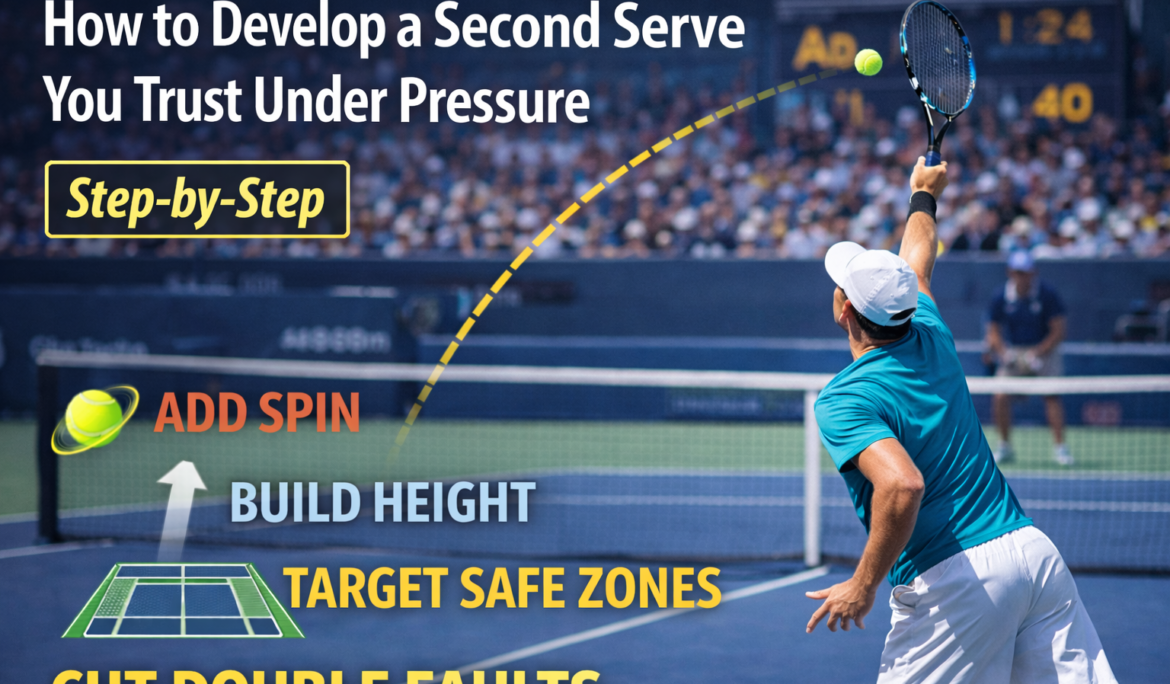
How to Develop a Second Serve You Trust Under Pressure (Step-by-Step)
If you want to win more matches, you must protect your second serve. When the score gets tight, the first serve often disappears. Therefore, your second serve becomes your real starting point.
This guide teaches you how to develop a second serve you trust under pressure. It is step-by-step, beginner-friendly, and built around simple checkpoints and practice routines.
Why your second serve breaks down in pressure moments
Pressure changes your timing. It also changes your choices.
Most players do one of two things when they feel stress:
-
They guide the ball in, which creates a weak “push” serve.
-
They swing harder, which lowers control and increases double faults.
However, a reliable second serve is not a “safe” serve. It is a repeatable serve with margin. It clears the net higher, uses spin, and lands deep more often.
The goal of a great second serve
A strong second serve should do three things:
-
Clear the net with margin
-
Drop into the box with spin
-
Start the point on your terms
You do not need an ace. You need a serve you can hit at 7–8 out of 10 effort and trust every time.
Therefore, the process is simple: build spin first, then add targets, then add pressure.
The three pillars of a reliable second serve
Before drills, lock these pillars. They matter more than fancy tips.
1) A grip that supports spin
A second serve needs a grip that allows the racquet to brush the ball. If your grip looks like a forehand grip, you will struggle to create safe spin.
2) A toss you can repeat
If the toss drifts, the serve drifts. This is true for beginners and advanced players.
3) A swing that goes up and brushes
A second serve is not pushed forward. It is swung up and over, with a brushing feel that creates rotation.
If you want to learn how to develop a second serve, start with these pillars. Everything else sits on top.
Quick self-check (no equipment needed)
Use this checklist before you practice.
-
Can you toss the ball to the same spot 7 out of 10 times?
-
Do you feel your racquet brushing up, not pushing forward?
-
Do your second serves clear the net comfortably, even at medium speed?
-
Can you aim at one big target and hit it more than half the time?
If you answered “no” to most of these, do not rush into advanced tactics. Build the base first.
Choose your second serve type: slice or kick
You have two practical options. Both can be reliable. Choose one to start.
Slice second serve (often easiest first)
-
The ball curves sideways and stays lower.
-
It feels natural for many adults.
-
It works well on faster courts.
Kick or topspin second serve (best long-term margin)
-
The ball jumps up after the bounce.
-
It gives the most net clearance margin.
-
It takes longer to learn, but it scales better.
If you are a complete beginner, start with a slice second serve. Then add kick later. If you already rally well and want maximum safety, start learning kick early.
Step-by-step plan to develop a second serve you trust
This is a four-phase plan. It fits beginners and improving players.
Phase 1: Build “spin margin” before speed (Week 1–2)
Your only job is net clearance plus spin. Do not chase pace.
Goal: 7 out of 10 second serves land in.
Target: Middle of the service box, not the lines.
Drill 1: Service-line spin serves
Stand on the service line.
-
Hit 30 serves with a smooth brushing swing.
-
Aim higher over the net than you think you need.
-
Let spin bring the ball down.
This teaches your brain that a second serve can be safe and aggressive at the same time.
Drill 2: Bounce height test
After each serve, watch the bounce.
-
Slice should skid and move sideways.
-
Kick should jump up and forward.
If the ball flies flat, you are not creating enough spin yet.
Drill 3: The “relaxed arm” reset
Tension kills spin.
-
Do 3 slow shadow serves.
-
Then hit 1 real serve with the same loose feel.
-
Repeat for 10 cycles.
However, keep effort moderate. A second serve breaks when you try to prove something.
Phase 2: Make the toss repeatable (Week 2–3)
Many players think they need a “different” toss for second serve. That often creates chaos.
Goal: One consistent toss lane.
Rule: Change as little as possible.
Toss lane drill
Pick a small window in front of your body.
-
Do 20 tosses and catch them at full reach.
-
Then hit 20 second serves using the same toss lane.
-
Track how many tosses felt “chase-free.”
If your toss pulls you forward or sideways, fix the toss before you fix anything else.
Phase 3: Add two simple targets (Week 3–4)
Once you land 7 out of 10 with spin, add direction.
Do not add three targets. Start with two.
Target A: Middle-deep in the box
Target B: Body serve (aim at the opponent’s hip area)
These two targets win points at every level. They also reduce double faults because they are big and practical.
Target ladder
Hit 10 second serves to Target A.
Then hit 10 to Target B.
If you miss 2 in a row, drop effort by 10% and rebuild rhythm.
Phase 4: Train pressure (Week 4–6)
You can only trust your second serve under pressure if you practice it under pressure.
Most players never do this. Therefore, their second serve collapses in matches.
Pressure drill 1: 10-in-a-row
This is simple and effective.
-
You must land 10 second serves in a row.
-
If you miss, start over at zero.
-
Stop after 15 minutes.
This drill builds the exact mindset you need in a tiebreak.
Pressure drill 2: Scoreboard serving
Create a fake score. Then serve like it matters.
Examples:
-
30–40 down
-
5–6 in a tiebreak
-
Ad out
Hit 5 second serves for each score situation. Use your normal routine every time.
Pressure drill 3: Second-serve only games
Play a short practice set where you only serve second serves.
This removes the “first serve escape.” It forces you to commit to your second serve identity.
A simple second-serve routine you can use every time
A repeatable routine makes your serve stable. It also reduces panic.
Use this 5-step routine:
-
Set your feet the same way each time
-
One deep breath
-
Same toss lane
-
Brush up and finish high
-
Hold the finish for one second
Therefore, your routine becomes your anchor when your mind tries to rush.
Common mistakes that stop second serve progress
These mistakes are easy to fix once you notice them.
Mistake 1: Trying to “baby” the ball in
Guiding the ball reduces spin. It also reduces margin.
Instead, swing smoothly and brush up. Spin is your safety.
Mistake 2: Practicing second serve only when you feel confident
That is backwards.
Practice second serve when you feel normal and when you feel annoyed. Pressure does not care about your mood.
Mistake 3: Changing too many things at once
If you change grip, toss, and swing in one session, you will get worse.
Change one variable per practice. Then keep it for a full week.
Mistake 4: Aiming too close to the net
Aiming low creates fear. Fear creates a push. Then the ball finds the net.
Aim higher. Let spin do the work.
The “second serve under pressure” weekly schedule
Use this if you want a clear plan.
| Week | Focus | What to measure | Weekly goal |
|---|---|---|---|
| 1 | Spin margin | Net clearance and bounce shape | 70% in, medium pace |
| 2 | Repeatable toss | Toss feels “chase-free” | 7/10 tosses consistent |
| 3 | Two targets | Middle-deep + body | 6/10 hit target zone |
| 4 | Routine | Same steps every serve | Routine stays stable |
| 5 | Pressure reps | 10-in-a-row drill | Reach 10 at least once |
| 6 | Match simulation | Second-serve only games | Fewer panic doubles |
This plan is how to develop a second serve without guessing.
How to fix double faults quickly during a match
Even with training, you will have a bad patch. Use this reset.
-
Choose the biggest target (middle-deep)
-
Add more spin, not more speed
-
Toss slightly higher, not farther forward
-
Finish high and hold the finish
This reset works because it restores margin first. Then confidence follows.
Frequently asked questions
How many second serves should I practice each week?
Aim for 60–120 second serves per week. That is enough for improvement without overloading your shoulder. However, quality matters more than total numbers.
Should my second serve toss be different from my first serve toss?
Keep it as similar as possible. A consistent toss reduces mental noise. Small changes are fine, but big changes often cause late contact and panic swings.
What is the best target for a second serve?
The best default is middle-deep in the box. It is a large target. It also reduces angles for the returner.
Why does my second serve get worse in tiebreaks?
Because the pressure changes your rhythm. Your body rushes. Therefore, you lose toss quality and spin. Pressure drills fix this faster than more “technique talk.”
Is a slice second serve good enough long-term?
Yes, if it has depth and bite. However, learning a kick serve later gives you more margin and a higher ceiling.
Final take
A second serve you trust is built, not found. First, create spin margin. Next, repeat the toss. Then add two targets. Finally, train pressure on purpose.
If you follow this plan, you will double fault less, start more points confidently, and feel calmer on big points. That is how to develop a second serve that holds up under pressure.