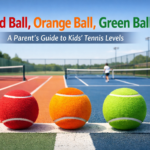




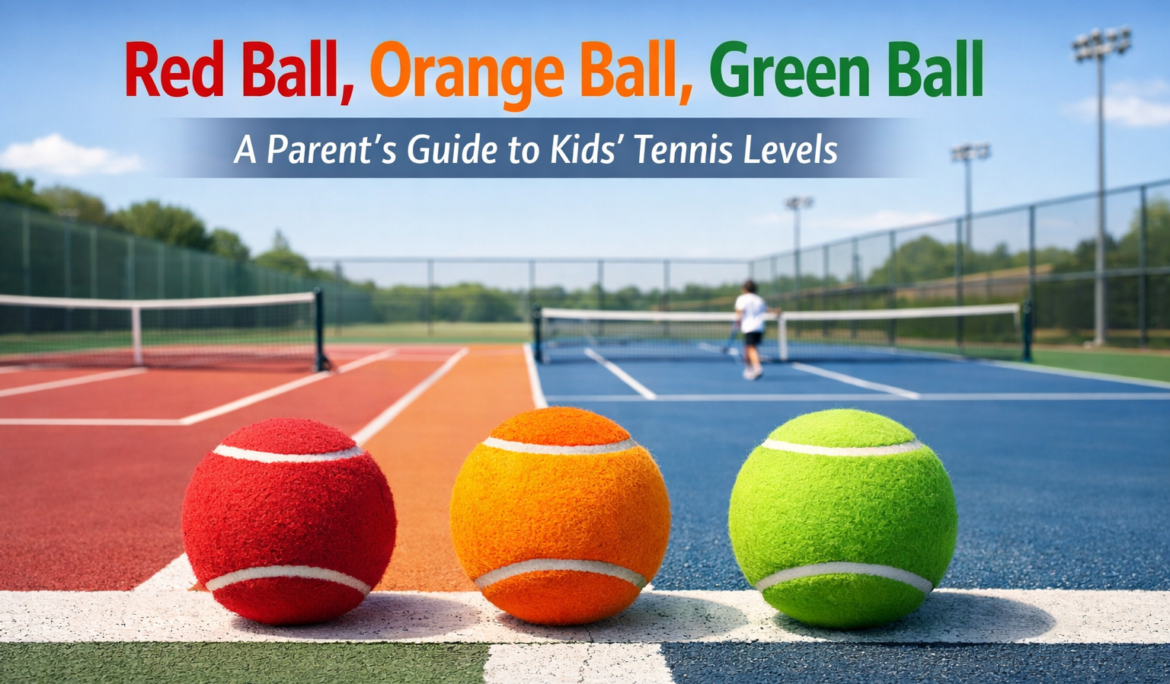
Your child just signed up for tennis — or you’re thinking about it — and someone mentioned red balls, orange balls, and green balls. Maybe the coach said “we’ll start on red” and you nodded, not entirely sure what that meant. Maybe you’re wondering if your 9-year-old should be on orange or green already.
You’re not alone. This is one of the most common questions we hear at Infinity Racquet Club in Fulshear. And the answer matters — placing a child on the wrong ball color is one of the most common reasons kids lose interest in tennis in their first six months.
This guide explains the entire USTA ball color system, in plain language for parents without a tennis background. By the end, you’ll know exactly which stage your child is likely at, what they should be learning at each stage, and how progression works at IRC.
Why Does Tennis Use Colored Balls for Kids?
Tennis wasn’t always taught this way. For most of the sport’s history, beginners — including very young children — were put on a full-size court with a full-size yellow ball and told to start hitting. The problem? A regulation tennis ball travels fast, bounces high, and requires significant strength and coordination to control. Most children simply weren’t physically ready for it, which led to frustration and a lot of kids quitting early.
In the early 2000s, the USTA (United States Tennis Association) introduced what’s now called the “10 and Under Tennis” or “QuickStart Tennis” program. The core idea was simple: scale the game down to the child’s body.
| “Slower balls. Smaller courts. Lower nets. Same love of the game — just sized right for the child in front of you.”
— Infinity Racquet Club coaching philosophy |
The result? Kids rally sooner, stay engaged longer, develop proper technique without fighting the equipment, and — critically — actually enjoy themselves from day one. The colored ball system is now used in USTA programs across the country and is the foundation of how we teach at IRC.
The Red Ball Stage
| 🔴 RED BALL
Stage 1 · Ages 4–7 · Complete beginners |
| Ages 4–7
Typical age range |
36 ft
Court length (vs 78 ft full) |
75% slower
Ball speed vs yellow |
The red ball bounces the slowest and lowest of all stages. It gives young children enough time to watch the ball, move their feet, and actually make contact — instead of swinging at air. The court is roughly a quarter the size of a full tennis court.
At this stage, the goal is not to build a competitive tennis player. The goals are:
- Learning to track a moving ball with their eyes
- Developing basic coordination between feet and racquet
- Understanding that tennis is fun and something they want to come back to
- Building the habit of ready position and split step
- Beginning to understand forehand and backhand grip differences
At IRC, red ball sessions use 19–21 inch racquets and focus heavily on games rather than technical drills. Children this age learn through play — not repetition. A red ball class might look chaotic from the fence, but there’s a structured progression underneath.
| ⚠ COMMON MISTAKE
Many parents assume that if their child is physically larger or already athletic, they can skip the red ball stage. We don’t recommend this. The red ball stage is about coordination development and technical habits — not just ball speed. A child who skips it often develops compensating techniques that are difficult to correct later, especially in their serve and backhand. |
The Orange Ball Stage
| 🟠 ORANGE BALL
Stage 2 · Ages 8–10 · Developing players |
| Ages 8–10
Typical age range |
60 ft
Court length |
50% slower
Ball speed vs yellow |
The orange ball bounces higher and faster than the red, but is still significantly slower than a full yellow ball. The court expands to 60 feet — roughly three-quarters of a full court. Children at this stage have enough coordination to begin developing real technique.
This is where the game starts to take proper shape. At IRC, orange ball players begin learning:
- Consistent forehand groundstroke with proper swing path
- Two-handed backhand fundamentals
- Continental grip for volleys and serve
- Basic serve motion — trophy position, toss consistency
- Court positioning: where to stand after a serve, how to approach the net
- Introduction to scoring — 15, 30, 40, game
- First match play situations in practice
This is also typically when children begin to identify as tennis players rather than just “kids taking tennis lessons.” The orange stage is where love of the sport really develops — or where it can fade if the program isn’t engaging enough.
| “The orange stage is where we see kids go from ‘I take tennis’ to ‘I love tennis.’ Getting this stage right is everything.”
— IRC Coaching Team, Fulshear |
The Green Ball Stage
| 🟢 GREEN BALL
Stage 3 · Ages 10–12 · Bridge to full game |
| Ages 10–12
Typical age range |
Full 78 ft
Court length |
25% slower
Ball speed vs yellow |
The green ball is the bridge between the junior program and full tennis. The court is now full-size — 78 feet — but the ball is pressurised at about 75% of a yellow ball’s speed. This means children can practice on a real tennis court while still having slightly more time to track and react.
The green ball stage is often where parents first see their child look like a “real” tennis player. At IRC, green ball players work on:
- Topspin forehand — the most important shot in modern tennis
- Slice backhand as a defensive and approach shot
- Serve development: kick serve basics, first vs second serve strategy
- Net approaches and volley technique under pressure
- Tactical patterns: cross-court rally, inside-out forehand, approach and finish
- Mental game: handling errors, staying focused between points
- USTA match play preparation for those interested in tournaments
Not every child stays on green ball for the same amount of time. Some players move through in six months; others spend a year or more here, deepening their technical foundation before moving to yellow. At IRC, we don’t rush this transition — moving too quickly to yellow can cause players to compensate technically in ways that limit their ceiling long-term.
The Full Yellow Ball — Full Tennis
| 🟡 FULL YELLOW BALL
Stage 4 · Ages 12+ · Full competitive game |
| Ages 12+
Typical transition age |
Full 78 ft
Court (singles lines) |
100%
Full regulation speed |
The full yellow ball is regulation tennis — the same ball used at Wimbledon, the US Open, and every professional and adult club match in the world. At this stage, players need strong technical foundations, consistent footwork, and the physical strength to generate pace and spin on their own.
Children who move through the red-orange-green progression with good coaching arrive at yellow ball ready. They have the muscle memory, the technique, and — crucially — the love of the game needed to keep developing. Players who were rushed to yellow before they were ready often plateau or quit entirely in their early teens.
At IRC, our Intermediate, Advanced, and Elite training groups all use the full yellow ball. Players here compete in USTA and UTR-ranked tournaments across the Houston area and Texas at large.
Quick Comparison: All Four Stages at a Glance
| Stage | Age Range | Court Length | Ball Speed | Racquet Size | USTA Level |
| 🔴 Red Ball | Ages 4–7 | 36 ft (¼ court) | ~25% of yellow | 19–21 inch | 10U Red |
| 🟠 Orange Ball | Ages 8–10 | 60 ft (¾ court) | ~50% of yellow | 23–25 inch | 10U Orange |
| 🟢 Green Ball | Ages 10–12 | Full 78 ft | ~75% of yellow | 25–26 inch | 12U / 14U entry |
| 🟡 Full Yellow | Ages 12+ | Full 78 ft | 100% | 27 inch (adult) | 12U, 14U, 16U, 18U |
Note: Age ranges are guidelines, not rules. At IRC, players are placed based on ability assessment, not birthday. A mature 7-year-old may start on orange; a returning 11-year-old might begin on orange to rebuild habits. Placement is always about long-term development.
| Not Sure Which Level Your Child Should Start At?
Our coaches assess every new player in a free 30-minute trial class before recommending a program. No guesswork, no pressure — just the right fit from day one. → Book Your Free 30-Minute Trial Class at IRC Open 6am–11pm · 7 days a week · 6215 Teal Rd, Fulshear TX |
How Do Kids Move Between Levels at IRC?
One of the questions we hear most from parents at IRC is: “How do I know when my child is ready to move up?” The honest answer is that readiness isn’t just about age — it’s about technical consistency, physical development, and mental readiness to handle faster balls and larger courts.
At IRC, progression is guided by our coaching team through regular assessments. We’re not looking for perfection — we’re looking for the habits that will allow a player to succeed at the next stage without getting overwhelmed or developing compensating techniques.
| What Our Coaches Look For Before Moving a Player Up
1. Consistent contact: Can the player reliably make contact with the ball at their current level — not 50% of the time, but the large majority of rallies? 2. Technical foundation: Is the player using the correct grip and swing path for their stage? A technically sound player on red ball will thrive on orange. A player who gets by with compensations will struggle. 3. Court awareness: Does the player understand where they should be on the court and move with intention between shots? 4. Emotional readiness: Can the player handle a ball that moves faster and bounces differently without shutting down emotionally? This matters more than most parents expect. 5. Physical development: Does the player have the arm strength and shoulder stability to swing at the next ball’s speed without risk of injury? |
Typically, a player spends 6 to 18 months at each ball stage, depending on how often they train and their individual development curve. Children training twice a week will progress faster than those training once a week — not just because of more repetition, but because the body’s motor memory develops faster with regular practice.
We never rush progression at IRC. A player who is fully ready for orange ball will thrive there immediately. A player who is rushed because they’re “the right age” will often plateau — and sometimes regress as they build compensating habits to deal with a ball they aren’t ready for.
Parent FAQs
My child is 9 but has never played before. Do they start on red or orange?
Almost always orange, but with some red ball elements in the early sessions. A 9-year-old has the physical coordination to handle the orange ball, but we’ll use some red ball drills to build technical habits cleanly before introducing full orange ball pace. In a free trial class, our coaches will assess exactly where to start.
Can my child play on the same ball they use at school?
This depends on what program their school uses. Many Katy and Fulshear school programs use orange or green balls. If your child is already comfortable at that stage, we’ll place them there at IRC. If their school uses full yellow but the child hasn’t built proper technique yet, we may bring them back to green to build those habits correctly — it’s not a step backward, it’s an investment in their ceiling.
How do I know if my child is in the right level at IRC?
Two good signs they’re in the right level: they’re challenged but not overwhelmed, and they leave class wanting to come back. Two signs they may need to move down: they’re consistently missing the ball, getting frustrated in most sessions, or have lost interest. Two signs they’re ready to move up: they’re dominating rallies easily, getting bored, and making clean contact consistently. When in doubt, talk to their coach — we track this and will flag it at the right time.
Does my child need to buy the colored balls to practice at home?
Yes — and it’s worth it. Practicing at home with a full yellow ball while training on red or orange at class creates confusing muscle memory. A bag of 12 red or orange balls is usually under $20 on Amazon. Even hitting against a garage wall 10 minutes a day between classes makes a significant difference in how quickly children progress. We’re happy to recommend specific brands that match what we use at IRC.
My child’s friend is the same age but already on green ball. Should I be worried?
Not at all — every child develops at a different pace physically and neurologically. A child who progresses to green ball at 10 is not inherently “better” than one who gets there at 11.5. What matters is whether they build the right habits at each stage. Rushed progressions often result in a ceiling around intermediate play. Patient progressions — where each stage is fully mastered — produce the advanced and elite players. We see this consistently at IRC.
Can adults use the colored ball system too?
Yes — and we recommend it for adult beginners. Many adults who “tried tennis once and couldn’t get it” were simply put on a full yellow ball before they were ready. An orange or green ball gives adult beginners enough time to rally successfully from the first lesson, which makes the learning experience far more enjoyable. Ask us about our adult beginner classes when you get in touch.
Explore IRC’s Programs for Every Level
Now that you understand the ball color system, here’s where to go next:
- IRC Academy Programs — see how our red, orange, and green ball classes are structured
- 2025 Summer Camps — beginner, intermediate, advanced, and pro camps in Fulshear this summer
- Junior Racquet Size Chart — which racquet size your child needs at each stage
- Meet Our Coaches — the team who will guide your child’s progression