



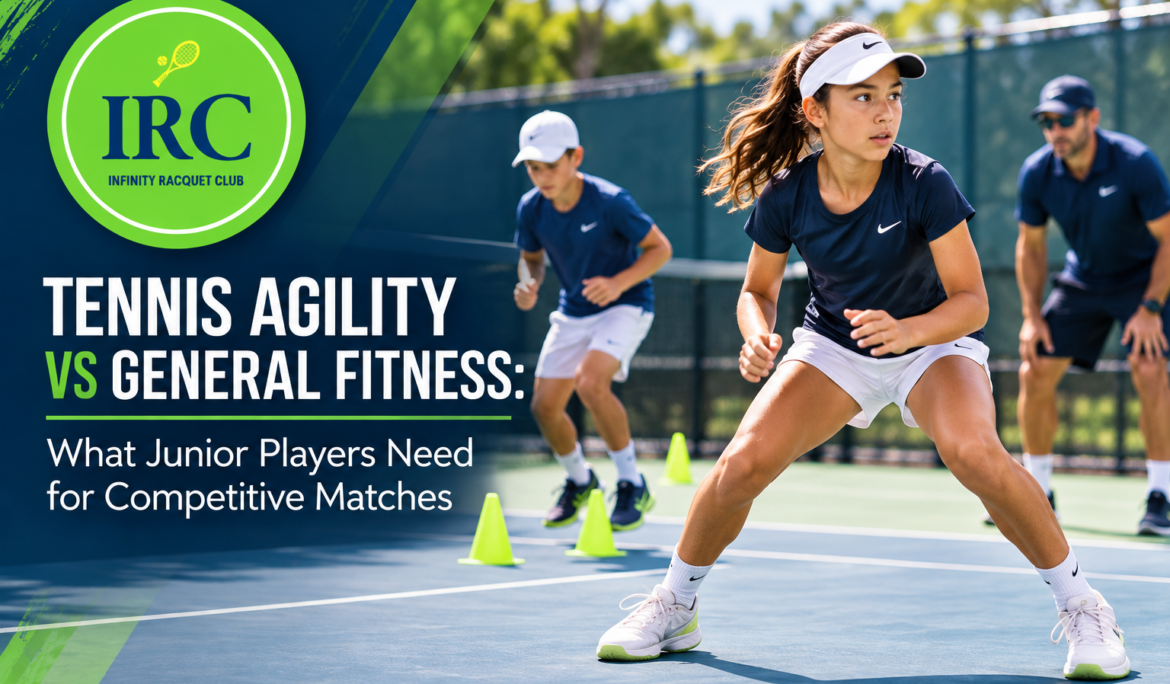
Tennis Agility vs General Fitness: What Junior Players Need for Competitive Matches
Many junior tennis players are active, athletic, and strong. They may run well, play other sports, or complete general fitness workouts. However, tennis requires a different type of movement.
A player can be generally fit and still feel slow during a match. That happens because tennis is not just about running. It is about reacting, stopping, changing direction, recovering, and hitting while balanced.
That is why Tennis Agility vs General Fitness is an important topic for junior players and parents. Both matter, but they do not train the same skills.
For junior players near Katy & Fulshear, understanding this difference can help improve match performance, court movement, and long-term development. Infinity Racquet Club, also known as IRC, is located at 6215 Teal Rd, Fulshear TX 77441, and serves players who want tennis coaching, court time, and structured player development.
This guide explains how tennis agility differs from general fitness and what junior players need for competitive matches.
What Is General Fitness?
General fitness is the overall physical foundation of an athlete.
It includes strength, stamina, flexibility, coordination, and basic conditioning. A generally fit player can move, train, and recover better than a player with poor conditioning.
General fitness may include:
- Running
- Bodyweight exercises
- Strength training
- Stretching
- Core work
- Jump rope
- Mobility exercises
- Basic conditioning circuits
These activities are useful. They help young athletes build a stronger body.
However, general fitness does not automatically teach a player how to move well on a tennis court. Tennis has its own movement demands.
What Is Tennis Agility?
Tennis agility is the ability to move quickly and efficiently in tennis-specific situations.
It is not just speed. It includes reaction, balance, direction change, footwork, recovery, and timing.
A junior player with strong tennis agility can:
- React quickly to the opponent’s shot
- Split step at the right time
- Take a fast first step
- Adjust before contact
- Stop without losing balance
- Recover after hitting
- Move forward for short balls
- Defend wide balls
- Return to position for the next shot
This is the movement that helps players compete in real matches.
A player may run fast in a straight line but still struggle with tennis agility. On court, the player must move in short bursts and change direction many times.
Tennis Agility vs General Fitness: Main Difference
General fitness builds the body. Tennis agility teaches the body how to move for tennis.
Both are important, but they solve different problems.
| Area | General Fitness | Tennis Agility |
| Main Goal | Build overall strength and stamina | Improve tennis-specific movement |
| Movement Type | Running, strength, conditioning | Split step, shuffle, recovery, direction change |
| Match Connection | Supports endurance and health | Supports real point movement |
| Training Style | Gym, field, or general workouts | Court-based movement and reaction drills |
| Best Result | Stronger physical base | Faster, smarter, more balanced court movement |
A complete junior tennis player needs both.
General fitness helps the player stay strong. Tennis agility helps the player move correctly during points.
Why Junior Players Need Tennis-Specific Movement
Competitive tennis is unpredictable.
The ball may come deep, short, wide, low, high, fast, or slow. The player must adjust within seconds. This requires more than fitness.
Tennis-specific movement helps juniors:
- Reach the ball earlier
- Hit from a balanced position
- Recover faster
- Reduce rushed swings
- Handle longer rallies
- Defend better
- Attack short balls
- Stay calm during pressure points
Many missed shots happen before the swing. The player may be late, off balance, or too close to the ball.
Better agility can fix many of these issues.
The Role of the Split Step
The split step is one of the most important tennis movement skills.
It is a small hop or bounce that prepares the player to move as the opponent hits. Without a split step, players often react late.
A good split step helps juniors:
- Start moving faster
- React in either direction
- Stay balanced
- Prepare before the ball arrives
- Avoid flat-footed movement
Many junior players know about the split step but do not use it during matches. That is why it must be practiced during drills and point play.
A strong Tennis Lesson should connect the split step to real rally situations.
First-Step Quickness Matters More Than Long-Distance Speed
Tennis rarely requires long-distance running.
Most points include short bursts. The first step often decides whether a player reaches the ball on time.
A junior player should train:
- Quick starts
- Side steps
- Short sprints
- Direction changes
- Reaction movement
- Recovery steps
A player does not need to be the fastest runner in school to move well on court. They need to react early and take the right first step.
First-step quickness can make a major difference in competitive matches.
Balance Is Part of Tennis Agility
Agility without balance can create problems.
A player may reach the ball quickly but still miss because they are off balance. Tennis requires controlled movement, not uncontrolled speed.
Balance helps players:
- Hit cleaner shots
- Control direction
- Recover faster
- Handle wide balls
- Avoid rushing
- Stay stable during serves and returns
Simple balance drills can help junior players develop better control. These may include single-leg holds, controlled lunges, shadow swings, and stop-and-hit movement drills.
The goal is not only to move fast. The goal is to move fast and hit with control.
Court Recovery: The Skill Many Juniors Forget
Many junior players move to the ball, hit, and then watch the shot.
In competitive matches, that habit creates problems. The opponent may send the next ball into open space.
Court recovery means moving back into a strong position after each shot.
Good recovery helps players:
- Cover the next ball
- Stay ready during rallies
- Reduce open-court gaps
- Build better point patterns
- Defend against stronger opponents
Recovery is a tennis-specific skill. It should be trained often.
A player who recovers well looks more prepared and confident during matches.
Why General Fitness Still Matters
Tennis agility is important, but general fitness still supports the whole player.
A junior player needs enough strength, endurance, and mobility to train consistently. Without general fitness, the player may get tired too early or struggle with longer sessions.
General fitness supports:
- Stamina
- Injury prevention
- Strength
- Flexibility
- Recovery
- Core control
- Overall athletic development
The key is balance.
General fitness should support tennis performance. It should not replace court-based movement training.
Tennis Agility Drills for Junior Players
Agility drills should match the player’s age, level, and movement needs.
The best drills connect to real tennis situations.
Split-Step Reaction Drill
The player starts in ready position. The coach points left or right, and the player reacts after a split step.
This builds timing and reaction speed.
Cone Shuffle Drill
The player shuffles between cones and returns to the middle after each movement.
This improves side movement and recovery.
Short Ball Sprint Drill
The player moves forward to a short ball, shadows or hits, then recovers.
This helps players attack short balls without rushing.
Wide Ball Recovery Drill
The player moves wide, practices a controlled swing, then returns to position.
This helps singles players defend and recover.
Serve Recovery Drill
The player serves, lands, and immediately prepares for the next shot.
This builds the habit of staying active after the serve.
These drills should be done with control. Quality matters more than speed alone.
General Fitness Exercises That Help Tennis Players
General fitness can support tennis when it is age-appropriate and safe.
Helpful exercises may include:
| Exercise Type | Tennis Benefit |
| Bodyweight squats | Builds leg strength |
| Lunges | Supports movement and balance |
| Planks | Builds core stability |
| Jump rope | Improves rhythm and coordination |
| Light medicine ball work | Supports rotation, when age-appropriate |
| Mobility drills | Helps movement range |
| Short interval running | Builds point-to-point conditioning |
Junior players should avoid doing too much too soon.
Training should support tennis, not create fatigue that affects technique.
What Junior Players Need for Competitive Matches
Competitive matches test more than strokes.
Players must move well, think clearly, and repeat effort under pressure. That requires a mix of agility, fitness, skill, and mental habits.
Junior players need:
- Reliable footwork
- Good split-step timing
- Quick first step
- Safe stopping
- Balance during contact
- Recovery after every shot
- Serve and return readiness
- Endurance for long rallies
- Mental reset after mistakes
These skills help players compete better against different opponents.
A strong junior player does not only hit well. They move well between shots.
How Agility Supports Match Play
Match play is where agility becomes visible.
A player with better agility can defend wide balls, attack short balls, handle quick changes, and recover faster during rallies.
Agility supports:
- Better rally consistency
- Smarter court positioning
- More confident defense
- Stronger transition to net
- Improved doubles movement
- Faster reaction to returns
- Better pressure-point movement
In matches, small movement improvements can change the result of many points.
One extra ball reached can extend the rally. One better recovery step can prevent an easy winner.
Agility for Singles vs Doubles
Singles and doubles require different movement habits.
Singles Agility
Singles players cover more court. They need side-to-side movement, endurance, and recovery.
Singles agility should focus on:
- Baseline movement
- Wide-ball recovery
- Short-ball movement
- Defensive footwork
- Recovery to center
- Long rally endurance
Doubles Agility
Doubles players cover less court but react faster at the net.
Doubles agility should focus on:
- Quick reaction steps
- Volley movement
- Split step timing
- Covering the middle
- Moving with a partner
- Serve and return positioning
Both styles need agility, but the movement patterns are different.
Common Mistakes Junior Players Make
Many juniors work hard but train the wrong movement habits.
Common mistakes include:
- Running without learning recovery
- Skipping split-step practice
- Moving fast but staying off balance
- Standing still after hitting
- Practicing only straight-line speed
- Ignoring footwork during lessons
- Training too hard before matches
- Not warming up properly
These mistakes can limit progress.
A better approach is to train movement the way it happens during points.
How Parents Can Support Tennis Fitness
Parents do not need to become fitness experts.
They can support junior players by encouraging consistency, proper warm-ups, recovery, hydration, and balanced training.
Parents should also avoid comparing their child’s fitness to another player’s. Every junior develops at a different pace.
Helpful parent support includes:
- Encouraging regular practice
- Asking the coach about movement goals
- Supporting rest days
- Helping maintain hydration
- Avoiding last-minute overtraining
- Focusing on effort and improvement
The goal is long-term development, not short-term pressure.
How Coaching Helps Connect Fitness and Tennis
A coach can help junior players connect fitness with real tennis movement.
Instead of doing random drills, players can learn movement patterns that match actual points. This makes training more useful.
A focused Tennis Lesson IRC approach can support:
- Split-step habits
- First-step quickness
- Footwork recovery
- Balance at contact
- Serve recovery
- Match movement
- Agility under pressure
Parents should contact IRC directly to confirm current lesson, training, and scheduling options.
This keeps expectations clear and avoids relying on outdated program details.
A Simple Weekly Balance for Junior Players
A junior player’s week should not include only matches or only fitness.
A balanced schedule may include technical lessons, match play, agility work, general fitness, and recovery.
| Training Area | Purpose |
| Technical lessons | Improve strokes and mechanics |
| Agility drills | Improve tennis-specific movement |
| Match play | Apply skills under pressure |
| General fitness | Build strength and stamina |
| Recovery | Protect long-term development |
The exact schedule depends on the player’s age, goals, and current level.
The best routine helps the player improve without burnout.
FAQs About Tennis Agility vs General Fitness
What is the difference between tennis agility and general fitness?
General fitness builds overall strength, stamina, and health. Tennis agility focuses on court-specific movement such as split steps, first-step reaction, side shuffles, recovery, and balance.
Do junior tennis players need both?
Yes. Junior players need general fitness for a strong athletic base and tennis agility for better match movement.
Why is agility important in competitive tennis?
Agility helps players react faster, reach more balls, stay balanced, recover after shots, and handle pressure during rallies.
Can a player be fit but still move poorly on court?
Yes. A player may have good endurance or strength but still struggle with tennis movement if they do not train split steps, recovery, and direction changes.
What agility drills help junior tennis players?
Split-step reaction drills, cone shuffle drills, wide-ball recovery drills, short-ball movement drills, and serve recovery drills can help junior players move better.
Should kids do strength training for tennis?
Kids can do age-appropriate strength work, usually focused on body control, balance, coordination, and safe movement. Parents should avoid heavy or advanced training without proper supervision.
Does IRC help junior players near Katy & Fulshear?
IRC is located in Fulshear near Katy and offers tennis coaching options. Parents should contact IRC directly to confirm current junior lesson and training availability.
General fitness helps junior players build a stronger body. Tennis agility helps them move better during real points. Competitive matches require both.
For families comparing Tennis Agility vs General Fitness, the answer is not one or the other. Junior players need a balanced approach that includes strength, stamina, split-step timing, quick reactions, balance, and recovery.
Junior players near Katy & Fulshear can contact Infinity Racquet Club at 6215 Teal Rd, Fulshear TX 77441, call 346-318-3556, or email infinityracquetclub@gmail.com to confirm current tennis lesson and training options.