




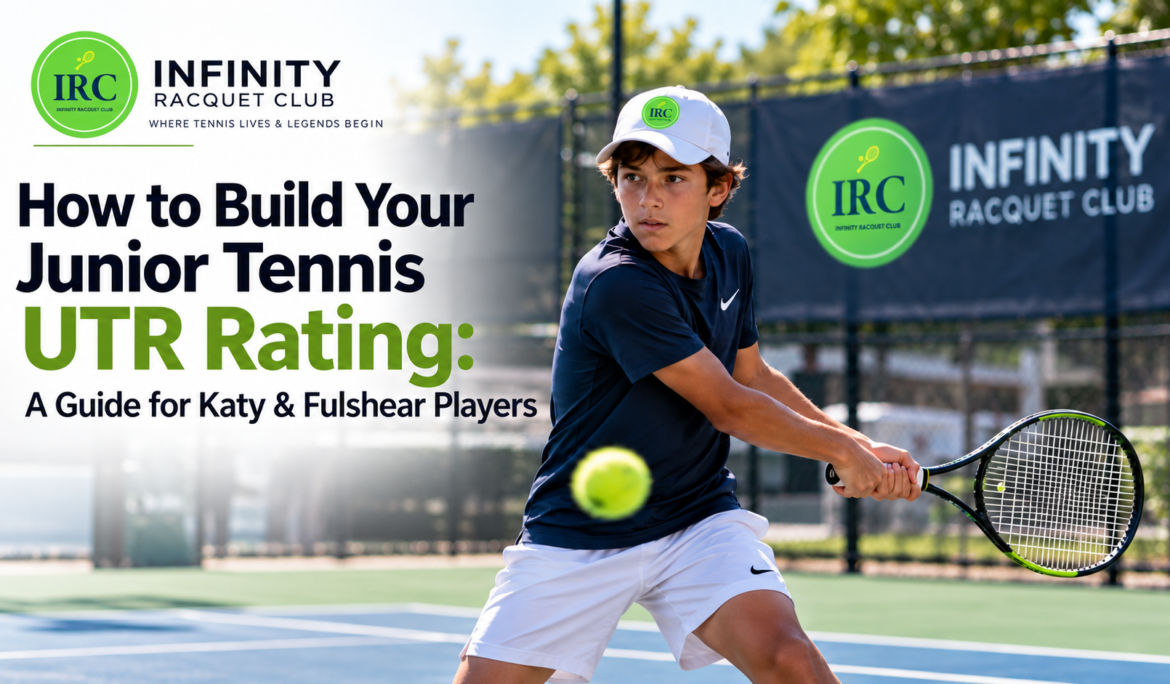
How to Build Your Junior Tennis UTR Rating: A Guide for Katy & Fulshear Players
For many junior tennis players, UTR becomes part of the tennis journey once they begin playing matches. Parents hear about ratings, tournament results, player levels, and match history, but it can feel confusing at first.
A Junior Tennis UTR Rating is not built from one great match. It develops through consistent match play, smart training, strong habits, and steady improvement over time.
For junior players in Katy & Fulshear, the goal should not be to chase a number every week. The better goal is to become a stronger player. When the player improves, the rating has a better chance to follow. Infinity Racquet Club, also known as IRC, is located at 6215 Teal Rd, Fulshear TX 77441. The club serves players near Katy and Fulshear who want tennis coaching, court time, and structured player development.
This guide explains how junior players can understand UTR, prepare for match play, and build better habits on and off the court.
What Is a Junior Tennis UTR Rating?
UTR stands for Universal Tennis Rating. It is a rating system used to measure a tennis player’s level based on match results.
For junior players, UTR can help show progress as they compete against different opponents. It can also help families understand which matches may be competitive and which events may fit the player’s current level.
However, UTR should not become the only goal. A rating is a result of performance. It is not the full picture of a player’s development.
A junior player still needs:
- Strong fundamentals
- Consistent practice
- Match experience
- Good footwork
- Serve confidence
- Mental toughness
- Smart shot selection
- Sportsmanship
When these areas improve, match performance usually improves too.
Why UTR Matters for Junior Players
UTR can be useful because it gives players and parents a clearer way to understand competitive level.
Instead of guessing based only on age or class level, UTR can show how a player performs in real matches. This can help with tournament selection, match planning, and development goals.
UTR may help players:
| Benefit | Why It Helps |
| Track progress | Shows movement over time |
| Find competitive matches | Helps players face similar-level opponents |
| Set realistic goals | Gives a measurable performance marker |
| Prepare for tournaments | Helps match level with event level |
| Build confidence | Shows improvement through match results |
Still, parents should remember that junior development is not always a straight line. A player may improve technically before the rating changes.
That is normal.
How UTR Is Built Over Time
A Junior Tennis UTR Rating is influenced by match results against rated players.
Players should understand that every match is part of the bigger picture. A single win or loss does not define the player. Consistent performance over time matters more.
A player can support their UTR growth by:
- Playing regular matches
- Competing against appropriate-level opponents
- Learning from losses
- Improving consistency
- Building serve reliability
- Reducing unforced errors
- Staying mentally calm
- Practicing under pressure
The key is steady development. Players who only chase easy wins may not grow enough. Players who only play matches far above their level may feel discouraged.
The right balance matters.
Start with the Right Match Level
Choosing the right matches is one of the most important parts of UTR development.
Junior players need matches that challenge them without overwhelming them. If every match is too easy, the player may not improve. If every match is too difficult, confidence may drop.
A good match should push the player to compete, think, move, and adjust.
Parents should ask:
- Is this opponent close to my child’s level?
- Will this match help my child learn?
- Is my child ready for this type of pressure?
- Does the event match the player’s current stage?
- Will the player stay motivated after the match?
The goal is not only to win. The goal is to grow through competitive experiences.
Build Consistency Before Chasing Winners
Many junior players want to hit big winners. Big shots are exciting, but consistency usually builds stronger match results.
A player who can keep the ball in play, control depth, and make fewer errors often performs better in junior matches.
Junior players should work on:
- Rally tolerance
- Cross-court control
- Deep ball placement
- Safer targets
- Better recovery
- Reduced unforced errors
- Patience during longer points
Before trying to finish points too early, players should learn how to build points.
Consistency does not mean playing scared. It means making smart choices and giving yourself a better chance to win points.
Serve Reliability Is Critical
The serve starts every service point. If a junior player double faults often, it becomes difficult to build momentum.
A strong serve does not need to be the fastest serve. It needs to be reliable, repeatable, and placed with purpose.
Players should focus on:
- Consistent toss
- Balanced stance
- Smooth rhythm
- Clean contact
- Reliable second serve
- Target practice
- Recovery after serve
A dependable second serve is especially important. It helps players stay calmer under pressure.
As players improve, they can add spin, placement, and pace. However, reliability should come first.
Learn How to Return Serve
Many junior players practice serving but ignore returns.
Return of serve matters because every return game starts under pressure. If the player cannot return consistently, it becomes hard to compete against stronger opponents.
A good return does not need to be aggressive every time. It should be controlled and purposeful.
Useful return goals include:
- Get the return in play
- Aim deep through the middle
- Avoid risky sidelines
- Prepare early
- Move forward when needed
- Recover after contact
For doubles, return placement is also important. A smart return can help the team start the point with better positioning.
Improve Footwork and Court Movement
Footwork can make a big difference in junior tennis.
Many missed shots happen because the player arrives late, stands too close, or hits while off balance. Better movement helps players hit cleaner shots and recover faster.
Junior players should work on:
- Split step
- First step reaction
- Side shuffle
- Forward movement
- Recovery steps
- Balance at contact
- Movement after wide balls
Good footwork also improves confidence. When players feel faster and more balanced, they make better decisions.
A focused Tennis Lesson should connect technique with movement. Players need to learn how to hit and how to get into position.
Practice Match Play, Not Only Drills
Drills are important, but matches teach different skills.
A player may look strong during practice but struggle when points matter. That is why match play is essential for UTR development.
Match play teaches players how to:
- Handle nerves
- Adjust to opponents
- Make decisions
- Manage score pressure
- Stay focused after mistakes
- Compete when tired
- Use patterns that work
Practice sets, tiebreaks, point games, and match simulations can help players become more comfortable under pressure.
This is where a strong training environment matters. Players need both repetition and real point play.
Learn from Losses
Losses are part of junior tennis.
A loss does not mean the player is failing. It means there is information to learn from.
After a match, players should review:
| Question | Purpose |
| What worked well? | Builds confidence |
| What broke down? | Shows training needs |
| Did I serve well under pressure? | Measures reliability |
| Did I make smart shot choices? | Improves tactics |
| Did I recover after mistakes? | Builds mental strength |
| What should I practice next? | Creates a clear plan |
Parents should avoid turning every loss into criticism. A calm review helps players improve without fear.
The best players learn faster because they study their matches honestly.
Build Mental Toughness
Mental toughness is important in UTR matches because the score can change quickly.
A player may start strong, lose focus, then struggle to reset. Another player may lose the first few games but fight back with patience.
Mental toughness includes:
- Staying calm
- Playing one point at a time
- Resetting after mistakes
- Avoiding negative self-talk
- Competing until the end
- Respecting the opponent
- Listening to coaching feedback
Junior players need to understand that emotions are normal. The goal is not to feel nothing. The goal is to respond better.
A player with strong mental habits can compete more consistently.
Keep a Simple Match Journal
A match journal can help players track progress beyond the rating.
After each match, the player can write a few notes. This does not need to be complicated.
A simple journal may include:
- Opponent name
- Match score
- What worked
- What needs work
- Serve performance
- Return performance
- Mental focus
- Next practice goal
This helps players see patterns over time.
For example, if a player keeps losing points on second serves, the practice goal becomes clear. If the player struggles with short balls, that becomes the next focus.
A journal turns matches into learning tools.
Avoid Chasing the Rating Too Much
UTR can be useful, but players should not obsess over it.
When junior players focus only on rating changes, they may become nervous, avoid tough matches, or feel disappointed after one bad result.
Instead, players should focus on controllable goals.
Good controllable goals include:
- Make more first serves
- Move feet before every shot
- Aim cross-court during rallies
- Stay calm after mistakes
- Use safer targets under pressure
- Compete hard until the last point
These goals help players improve regardless of the score.
Ratings can go up and down. Habits build long-term progress.
How Parents Can Support UTR Growth
Parents play a major role in junior tennis development.
Support does not mean pressure. It means helping the player stay consistent, calm, and motivated.
Parents can support their child by:
- Encouraging regular practice
- Helping schedule matches
- Focusing on effort, not only results
- Avoiding harsh post-match criticism
- Asking what the player learned
- Keeping tennis enjoyable
- Trusting the development process
The car ride after a match matters. A calm, supportive conversation can help players process the match better.
Junior players perform better when they feel supported, not judged.
Weekly Training Habits for Junior UTR Development
Junior players need a balanced routine.
A good week should include technique, movement, match play, serve practice, recovery, and rest. More training is not always better if the player becomes tired or frustrated.
A balanced routine may include:
| Training Area | Why It Helps |
| Technical lessons | Builds better strokes |
| Serve practice | Improves point starts |
| Footwork drills | Supports better court coverage |
| Match play | Builds competitive confidence |
| Fitness work | Improves movement and endurance |
| Recovery | Helps avoid burnout |
This structure helps players develop without relying only on tournaments.
How Coaching Helps Build a Junior Tennis UTR Rating
Coaching helps players understand what to improve and how to practice.
A coach can identify technical mistakes, movement issues, serve problems, and match habits that may not be obvious to the player or parent.
A focused Tennis Lesson IRC experience can help junior players work on:
- Stroke technique
- Serve development
- Return strategy
- Footwork
- Shot selection
- Match patterns
- Confidence
- Tournament preparation
Parents should contact IRC directly to confirm current junior lesson availability, scheduling, and training options.
Common Mistakes Junior Players Make
Many junior players work hard but lose points from repeat mistakes.
Common mistakes include:
- Going for winners too early
- Double faulting under pressure
- Standing still after hitting
- Avoiding the backhand
- Not recovering after wide balls
- Getting upset after one mistake
- Playing without a plan
- Ignoring warm-ups
- Focusing only on the rating
These mistakes can improve with coaching, awareness, and consistent match play.
The key is to correct one habit at a time.
What Junior Players Should Bring to Match Play
Good preparation helps players feel more confident.
Before matches or practice sets, players should bring:
- Tennis racquet
- Backup racquet, when available
- Tennis shoes
- Water bottle
- Towel
- Hat or visor
- Sunscreen
- Extra grip
- Snacks
- Match notes or journal
Players should also arrive early enough to warm up properly.
Small habits can improve match readiness.
FAQs About Junior Tennis UTR Rating
What is a Junior Tennis UTR Rating?
A Junior Tennis UTR Rating is a tennis level rating based on match results. It helps players and parents understand competitive level and track progress over time.
How can junior players improve their UTR rating?
Junior players can improve by playing regular matches, choosing appropriate competition, reducing errors, improving serve reliability, practicing match play, and learning from losses.
Should players only play opponents they can beat?
No. Players should seek competitive matches that challenge them. Easy matches may not help development, while matches that are too difficult can hurt confidence.
Is UTR more important than skill development?
No. UTR is useful, but skill development matters more. Better technique, movement, consistency, and mental habits usually support better match results over time.
How often should junior players compete?
The right frequency depends on age, level, schedule, and readiness. Parents should balance tournaments with training, recovery, school, and family life.
Can coaching help with UTR improvement?
Yes. Coaching can help players improve technique, movement, serve reliability, return strategy, match habits, and confidence.
Does IRC help junior players near Katy & Fulshear?
IRC is located in Fulshear near Katy and offers tennis coaching options. Parents should contact IRC directly to confirm current junior lesson availability and scheduling.
Building a Junior Tennis UTR Rating takes time, patience, and consistent effort. Players should focus on becoming better competitors, not only on watching the number change. The best path includes strong fundamentals, match play, serve reliability, footwork, mental toughness, and steady coaching support.
Junior players near Katy & Fulshear can contact Infinity Racquet Club at 6215 Teal Rd, Fulshear TX 77441, call 346-318-3556, or email infinityracquetclub@gmail.com to confirm current junior tennis lesson and training options.